Spyderco Dragonfly 2 Emerson Opener Folding Knife C28PGYW2
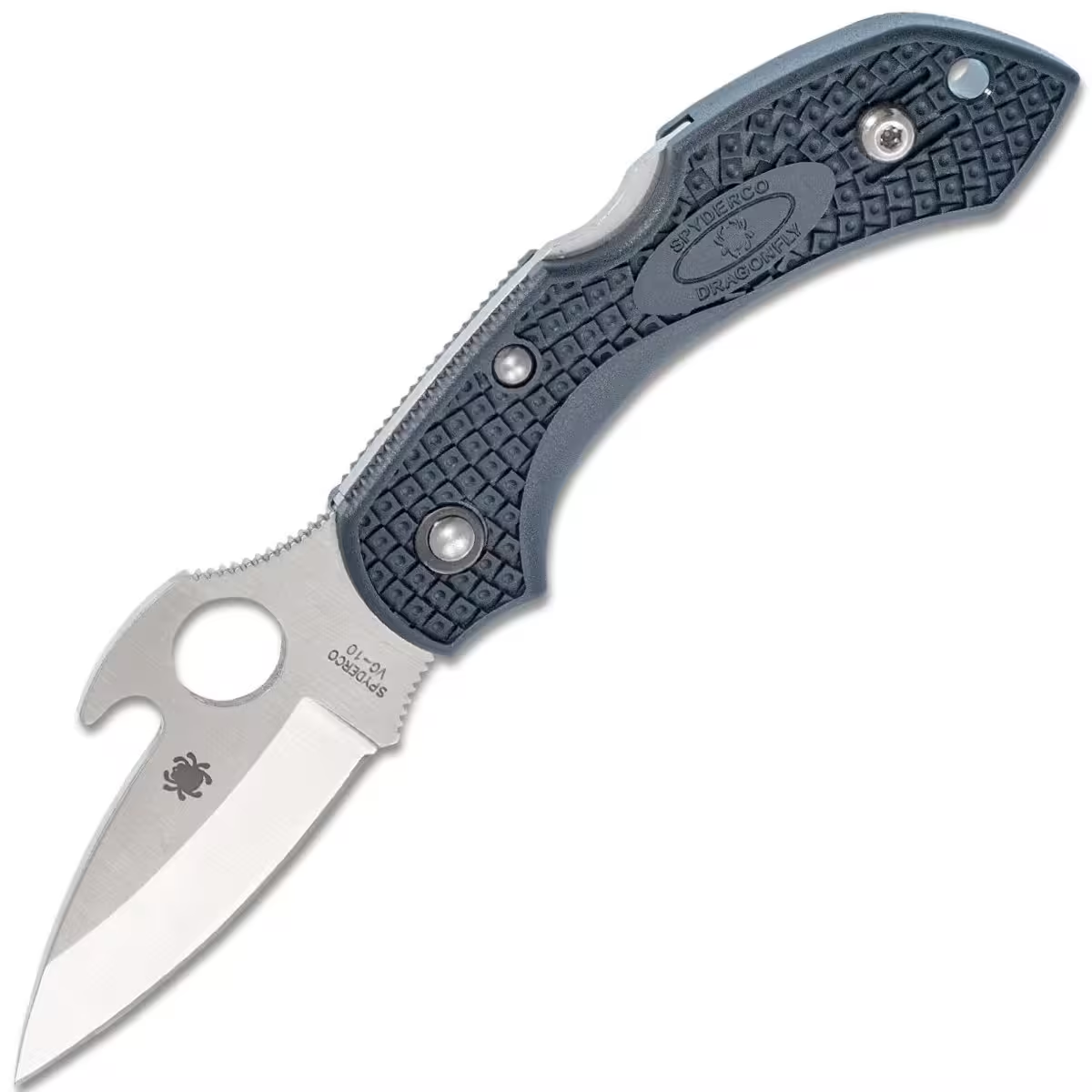
One of the drawbacks of compact knives is that opening them one-handed can be somewhat more difficult. The Dragonfly 2 Emerson Opener solves this problem by upgrading the popular Dragonfly 2 Lightweight with an Emerson Opener.
Detailed product description
Spyderco Dragonfly 2 Emerson Opener Folding Knife C28PGYW2
One of the drawbacks of compact knives is that opening them one-handed can be somewhat more difficult. The Dragonfly 2 Emerson Opener addresses this issue by enhancing the popular Dragonfly 2 Lightweight with an Emerson Opener—an integrated hook that catches the edge of the pocket and automatically opens the blade as the knife is drawn. This high-speed version of the Dragonfly 2, with its signature dark gray FRN handle and non-slip bi-directional texture, proudly includes all the other defining features of this popular model. Note: Spyderco calls it a dark gray FRN handle, but the actual appearance is closer to dark blue.
Emerson Opener
Ernest Emerson has had a profound impact on the knife industry and on both the form and function of the modern tactical folding knife. Although the scope of his influence is extremely broad, perhaps his most revolutionary innovation was the “Emerson Opener.” Also known as the “Wave Shaped Feature” or more colloquially—and inaccurately—the “Wave,” it consists of a small integrated hook on the spine of a folding knife blade. When the closed knife is carried tip-up and drawn from the pocket, the hook catches on the pocket edge and quickly rotates the blade into the open position. If you need to use your folding knife in a hurry, the Emerson Opener is your fastest option.
Ernest Emerson’s knifemaking journey
Ernest Emerson, a native of northern Wisconsin, was born on March 7, 1955. In high school he was a gifted athlete, and he began his lifelong obsession with martial arts at age 16 by training in Yudo, the Korean version of judo. He attended the University of Wisconsin-Lacrosse and earned degrees in physical education and world history, as well as a brown belt in Kyokushinkai Karate and a black belt in Shotokan Karate.
Immediately after graduation, Emerson moved to Southern California with the sole goal of expanding his martial arts education at the famed Inosanto Academy of Martial Arts under Bruce Lee protégés Dan Inosanto and Richard Bustillo. There he studied the Filipino art of Kali and Bruce Lee’s systems of Jun Fan Gung Fu and Jeet Kune Do. He later also trained in Brazilian Jujitsu under the renowned Royce and Rorion Gracie. During this time, Emerson supported himself as a machinist and designer for Hughes Aircraft.
In 1978, as part of his study of Filipino martial arts, Emerson found that he needed a balisong, or butterfly knife. At the time, balisongs were not commonly available, so he decided to make his own. When his classmates saw it, they asked Emerson to make knives for them as well. Balisongs quickly led to fixed blades and then, after seeing Michael Walker’s custom LinerLock folder at a gun show, eventually to folding knives. With Walker’s blessing, Emerson began making LinerLock folding knives and soon became a full-time knifemaker. Inspired by his work in the aerospace industry, he incorporated state-of-the-art, high-performance materials and focused on meticulously crafted knives of investment quality.
In the mid-1980s, Emerson shifted his focus to more Spartan, tactically oriented designs. He also adopted the single-side chisel grind—a signature feature of the knives made by fellow knifemaker Phil Hartsfield, who supplied knives to members of the West Coast US Navy SEALs. When the SEALs asked Hartsfield to make folding knives, he explained that he only made fixed blades and introduced them to Emerson. Emerson’s folders quickly became essential gear among the SEALs, and that popularity soon spread to other U.S. and foreign special operations units and elite law enforcement agencies. This later led to collaborations with several leading commercial knife manufacturers and ultimately to Emerson Knives, Inc., Emerson’s own knife company, which he founded with his wife Mary.
Emerson’s legendary designs have been exhibited at the Metropolitan Museum of Art and the Smithsonian Museum—an unprecedented achievement for a knifemaker—and his knives continue to be trusted by some of the world’s most elite warriors.
The birth of the Emerson Opener
The Emerson Opener is one of the most dynamic knife-related innovations ever developed and has been used over the years—with and without Emerson’s blessing—on countless knives. The actual invention of this feature, however, was accidental. According to Emerson, instructors from the U.S. Navy SEALs Combat Fighting Course wanted to develop a specific knife for combat use. One of the elements they wanted in the design was a “blade catcher” on the spine of the blade to protect the user’s hand. Emerson incorporated this feature into his iconic Commander model and chose to shape it like a small ocean wave. When he completed the first prototypes of the design, several SEALs from the U.S. naval base in Coronado came to his shop to pick them up for testing and evaluation.
Shortly after the SEALs left, Emerson drew his prototype knife and suddenly realized that when he cleared his pocket, the “blade catcher” snagged and partially opened the blade. At first, he was concerned that it might be a safety issue, but when he repeated the experiment with more force, he realized that the feature opened the blade reliably and very quickly. Just as he had this revelation, the phone rang in his shop. It was the SEALs from Coronado, who had just returned to base, begun evaluating the knife, and discovered the same amazing auto-opening function of the “blade catcher.”
Because of its shape, Emerson named his invention the "Wave" and applied for a utility patent on it in 1997. This patent, No. 5 878 500, was granted in March 1999, but after another knife and tool company, Leatherman, used the trademark “Wave,” Emerson changed the official term for knife use to “wave shaped opening feature.” He also made it a required feature on all knives his company produced for military and law enforcement contracts.
Spyderco co-founder Sal Glesser, an eager follower of all new developments in the knife industry, appreciated the brilliance of Emerson’s invention and approached him about the possibility of licensing it for use on selected Spyderco designs. In 2006, we released versions of the popular Delica 4 and Endura 4 Lightweights that proudly featured our expression of the Emerson Opener. To confirm Spyderco’s formal license for this feature, Emerson’s patent number was engraved on the back side of the blade.
Since then, the “wave shaped opening feature” has appeared on a number of other Spyderco models, including the Rescue 93mm, Endura and Delica Trainers, Matriarch 2, Karahawk, Tropen, and P'Kal and P'Kal Trainer, which are unique in featuring a removable Emerson Opener that screws into the blade spine. More recently, Emerson’s invention has been incorporated into the Endela Lightweight, Dragonfly 2, and Byrd Cara Cara 2 Lightweight, as well as several limited-edition exclusive models, including versions of the popular Paramilitary 2.
In January 2016, Ernest Emerson was granted U.S. registered trademark #4 879 356 for the iconic proprietary design of his “Wave Shaped Feature.” His utility patent expired in 2017, and since then many knives have been made using the Emerson Opener without crediting Emerson or his revolutionary innovation. There are also countless improvised devices, blade modifications, and aftermarket accessories that imitate the function of the Emerson Opener. But nothing beats the original. To that end, Spyderco continues to officially license this unique feature from Emerson—even after the patent expired—and is immensely proud of the long-standing friendship we enjoy with this legendary knifemaker.
PROPER USE OF THE EMERSON OPENER
Edge-U-Cation®
Unlike standard one-hand-opening folding knives or even automatic knives that allow rapid blade deployment after the knife is drawn, the Emerson Opener deploys the blade as it clears the pocket and is therefore the fastest opening method available. Achieving this speed, however, still requires proper carry and good technique.
As with any new skill, it is best to start slowly. If possible, first use a trainer version of the Emerson Opener knife and only move to a live blade when you feel ready. To prevent property damage or injury to others, always make sure there are no people or obstacles in the area around you before opening the knife. Also, because the Emerson Opener hooks on the pocket mouth, it works best with trousers made from sturdy fabric. Dress pants and other trousers made from lightweight fabrics are not suitable for use with this opening method.
Standard grip:
To draw and open the knife into a standard grip—so that the blade extends from the thumb side of your hand—first make sure it is configured for tip-up carry by attaching the clip to the butt end of the handle. Clip the closed knife to your pocket with the body of the knife inside the pocket and the knife positioned all the way to the back of the pocket. The blade spine should face rearward.
Reach your thumb into the pocket as deeply as possible and press it firmly against the side of the knife handle. At the same time, curl your fingers so that your index finger hooks under the tip of the clip. Apply pinching pressure between your thumb and fingers to secure a firm grip on the knife. As you lift the knife upward, apply slight rearward pressure to keep the blade spine against the back of the pocket. When the Emerson Opener catches on the pocket mouth, continue the draw so that your arm extends slightly behind you and the blade safely clears your body to lock in the fully open position.
Practice these movements slowly and carefully until you are completely comfortable with them. Then gradually increase speed while still focusing on safety.
Reverse grip:
Spyderco knives with Emerson Openers can also be configured to be drawn into a reverse grip, with the blade extending from the little-finger side of the hand. To configure your knife for this type of draw, mount the clip at the butt end of the handle so that the spine of the closed blade faces forward when the knife is clipped to the pocket. For best results, clip the knife farther forward in the pocket, closer to the body’s centerline.
To draw from this position, reach your thumb deep into the pocket and press it against the knife handle. As you do this, make sure the web of your thumb is at the back of the handle butt. Place the fingertips of your index and middle fingers on the base of the clip and apply pressure between them and your thumb. Grip the handle firmly and pull the knife from the pocket. While doing so, apply forward pressure to slide the spine of the closed blade against the front of your pocket. As soon as the knife clears the pocket, the Emerson Opener will catch the pocket edge and rotate the blade into the open position.
Again, practice these movements slowly and carefully and master them thoroughly before increasing speed. In the process, you will find that at least a modest degree of speed is required for the blade to fully deploy and lock.
Drawing without opening:
If you do not need to open your Emerson Opener-equipped knife in a hurry, you can also draw it without automatically opening the blade. To do this, use the same grip and mechanics described earlier, but pull the knife through the center of the pocket without allowing the hook to catch on the pocket mouth. You can also use your index finger to apply pressure to the blade spine and keep it closed while drawing the knife.
The Emerson Opener is a unique feature that significantly increases the speed and ease of deploying our knives. To get the most from it, remember the Navy SEAL saying: “Slow is smooth and smooth is fast.” Take your time, and smooth and fast will come naturally.
Specifications
Closed Length: 8.5 cm
Blade Style: Spear Point
Blade Grind: Saber
Blade Finish: satin
Blade Edge: Plain
Handle Color: dark gray
Locking Mechanism: Lockback
Pocket Clip: Tip-Up, left/right carry
Model Number: C28PGYW2
Model Name: Dragonfly 2 Emerson Opener
Patented Emerson Wave
Made in Japan
Key parameters
Overall length
14.2 cm
Blade length
5.8 cm
Weight
1,3 oz. (37 g)
Steel
VG10 stainless steel
Handle
Obousměrná texturovaná FRN
Blade thickness
0.25 cm
Customer reviews
All 147 reviews →4,8
★★★★★
147 reviews · Heureka verified
You may also like
More →