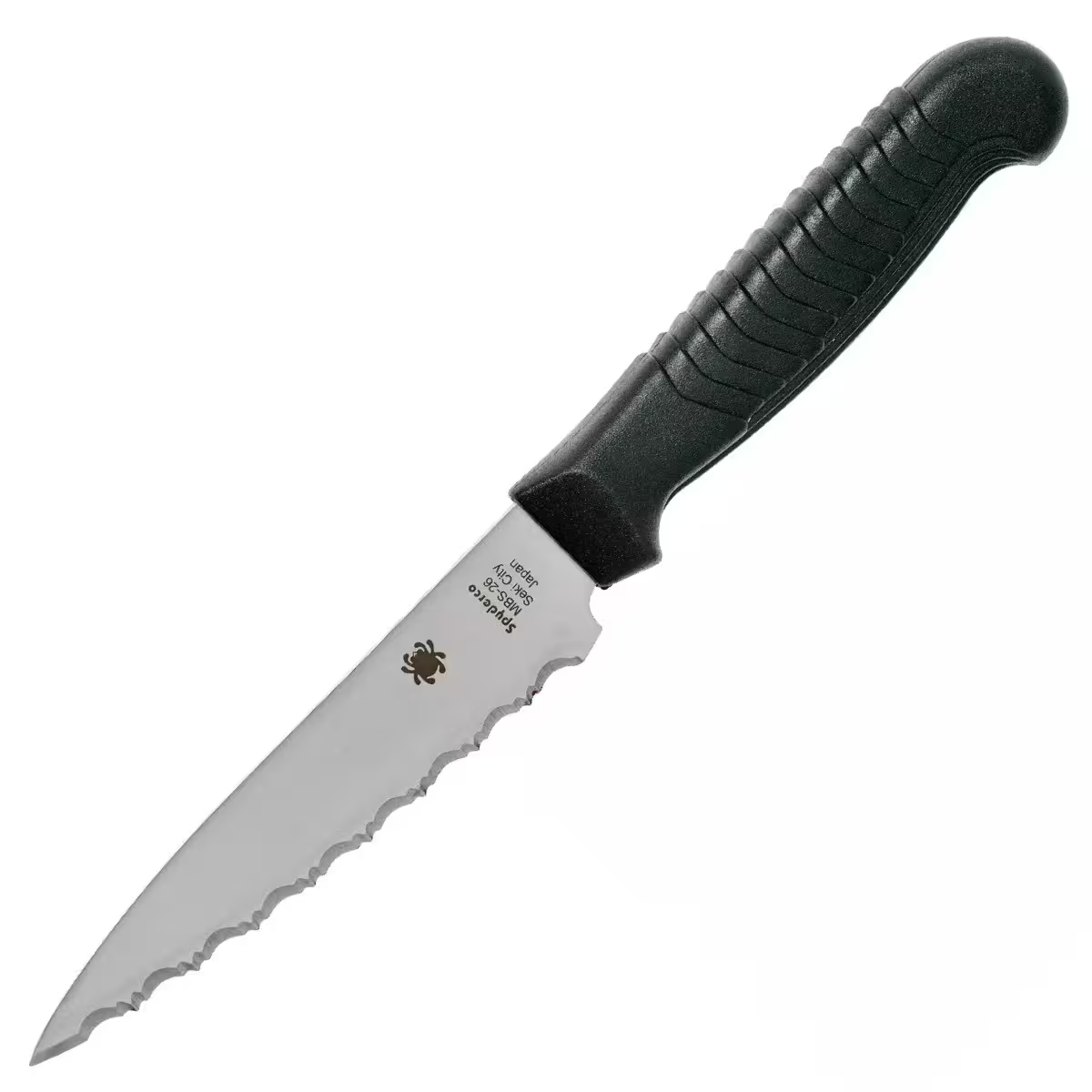
Spyderco Endela Wharncliffe Lightweight C243FPWCBK Folding Knife
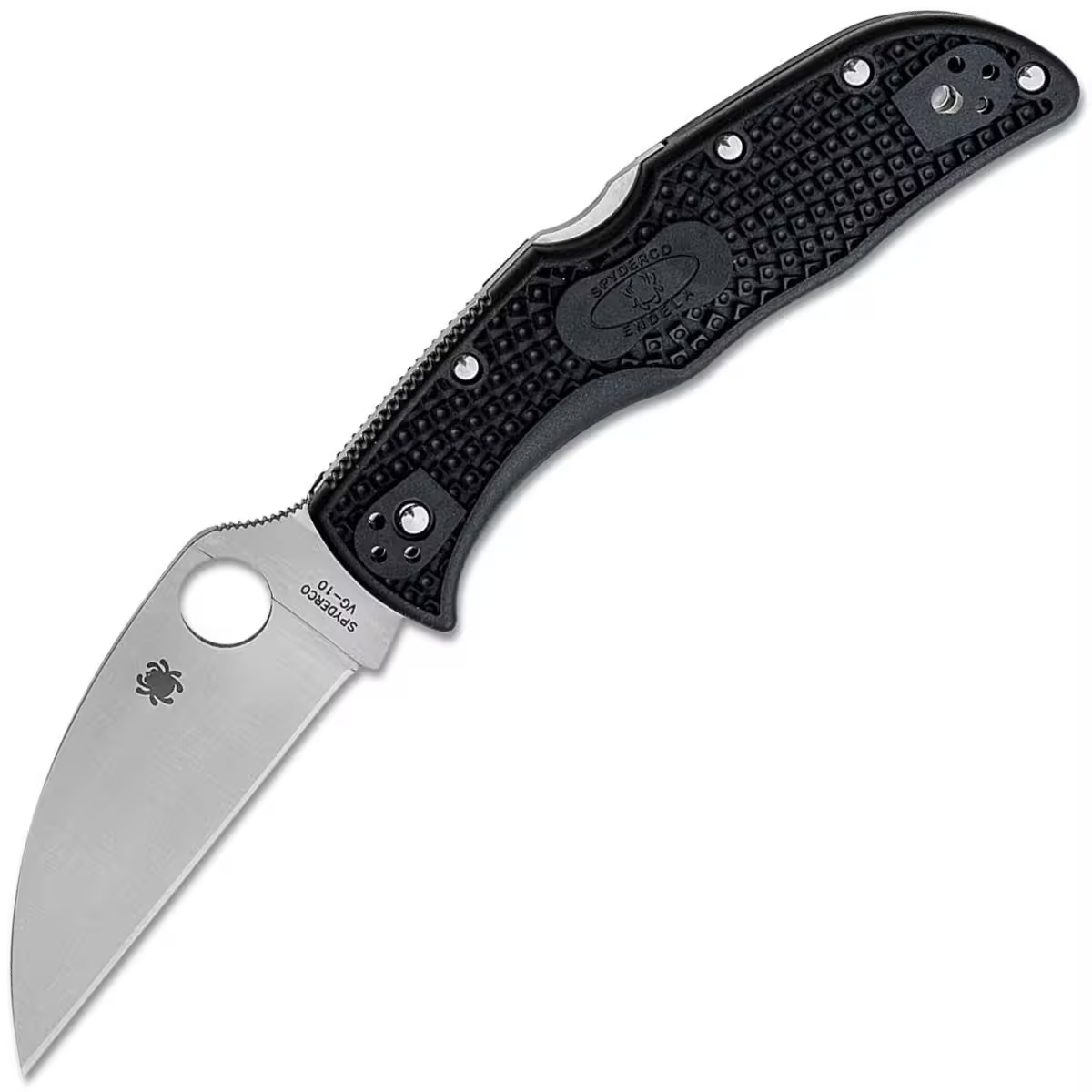
The Endela Lightweight Wharncliffe offers unmatched cutting performance and control in the perfect in-between size.
Detailed product description
Spyderco Endela Wharncliffe Lightweight C243FPWCBK Folding Knife
The more time you spend around knives, the more you realize there is no universal cutting tool. Just as importantly, there is no single handle shape that suits everyone. Human hands are organic and vary significantly from person to person. If you are not completely satisfied with straight, uninspired, and relatively bland handle designs, some knife handles will simply “feel” better in your hand than others. That is a big part of the charm of knife design and a critical part of appreciating the wide range of knives available to us.
Spyderco Delica and Endura are two of the most popular folding knives ever made. They have been produced continuously for more than 30 years, and each has inspired a number of variations on its basic form. Based on that proven track record, these venerable designs come as close as possible to pleasing the broadest range of knife users. For some, however, they still are not quite perfect. While the refined contours of their handles work well for most hands, the Delica may be too small for some and the Endura too large for others.
To solve this problem, Spyderco created the Endela in 2019. Designed to provide the perfect “Goldilocks” compromise between the Delica 4 and Endura 4 Lightweight, it literally splits the dimensional difference between the two while faithfully preserving all the highly refined, time-tested features of each. The original version features a full-flat-ground blade made from VG-10 stainless steel. Like the knives that inspired it, its blade has a straight spine, a subtle belly, and a pronounced “hump” for its fully accessible round hole for ambidextrous one-handed opening. Its lightweight handle is injection molded from fiberglass-reinforced nylon (FRN) and includes non-slip bi-directional texturing, skeletonized stainless steel liners, and a sturdy back lock mechanism with Boye Dent.
Available with your choice of a PlainEdge or fully serrated SpyderEdge blade, the Endela immediately became a classic. Like its predecessors, it also began to inspire additional variations, including a version with a saber-ground VG-10 blade and Emerson Opening Feature and a version with a K390 tool steel blade and distinctive blue FRN handle. The Endela was also proudly included in Spyderco’s unique Thin Blue Line and Thin Red Line series of knives created to honor the service of law enforcement officers and firefighters, and it has served as the platform for exclusive projects featuring different blade and handle materials, colors, and finishes.
The latest addition to the rapidly growing Endela family is the Endela Lightweight Wharncliffe. It combines the versatility and impressive cutting ability of the straight-edged Wharncliffe profile with the proven features and “in-between” size of the Endela Lightweight format. Like the classic nineteenth-century English Wharncliffe pocketknife blades, the spine of the Endela’s 3.40-inch (86mm) blade gracefully curves downward to meet the edge. Unlike traditional Wharncliffe blades, which tended to be narrow and thick, the Endela Wharncliffe’s blade has a broad profile and full-flat grind, giving it an exceptionally thin edge geometry for low-friction cutting performance.
The Endela Lightweight Wharncliffe offers unmatched cutting performance and control in the perfect in-between size.
History of the Wharncliffe
For many discerning knife users, the Wharncliffe-style blade represents the perfect synthesis of pocketknife form and function. Its deceptively simple profile, perfectly straight cutting edge, and acute point make it incredibly versatile and adaptable to a wide variety of tasks. Like the straight-edged utility knives used by craftsmen, it cuts with impressive power and delivers that power all the way to the tip. Like a scalpel or X-Acto knife, it also offers precision and control when working with the point.
Although Wharncliffe knives have become increasingly popular in recent years, they are by no means new. In fact, the original design dates back to the early nineteenth century and one of the world’s original centers of knife making, Sheffield, England. According to the book British Manufacturing Industries, second edition, published in London in 1878, “during the seventeenth century nearly all the cutlery manufactured for the use of Englishmen was of the plainest possible description.” It later states: “The trade may be said to have entered upon its new era about 1820, when the famous ‘Wharncliffe knife’ was invented. As the story goes, the first Lord Wharncliffe and his relative Archdeacon Corbett were one day drinking wine after dinner when the conversation turned to cutlery and to some small invention in the manufacture of spring knives. Not wishing to criticize where they could not improve, they put their heads together and with the aid of a practical man succeeded in producing a new pattern knife. It was submitted to Messrs. Rodgers, who adopted it and introduced to the world the ‘Wharncliffe knife,’ on which pattern the greater part of the spring knives now made for the home market are founded.”
The “first Lord Wharncliffe” cited here is Colonel James Archibald Stuart-Wortley-Mackenzie, 1st Baron Wharncliffe (6 October 1776 – 19 December 1845), a British soldier and politician who lived northwest of Sheffield in the village of Wortley. “Messrs. Rodgers” referred to the prestigious firm Joseph Rodgers & Sons, founded in Sheffield in 1724 and widely respected as “Cutlers to Her Majesty.” Also, to avoid any misunderstanding, the term “spring knife” referred to the period’s slipjoint knives with spring backs, not to any kind of switchblade or automatic knife. We know this because the same book refers to those a few pages later using the term “fly knife.”
While British Manufacturing Industries gives the Wharncliffe knife an origin date of “about 1820,” the colonel did not actually assume the title “Lord Wharncliffe” until 1826. The knife’s design therefore could not have originated earlier. As for production of the pattern, cutlery historians generally agree that Wharncliffe-pattern knives were made in Sheffield during the mid and late nineteenth century. Their hallmark was a blade with a straight edge and a thick, downward-curving spine. This blade style also migrated to America and was incorporated into factory-made pocketknives on this side of the Atlantic—though not necessarily with attribution to its namesake.
As blade patterns evolved and more task-specific profiles emerged, the lines between the Wharncliffe and other straight-edged styles such as sheepsfoot, coping, and lambfoot also began to blur. Some pocketknife styles, such as the swayback pattern and certain whittler designs, also featured Wharncliffe-style blades without ever naming them as such. Nevertheless, the functionality and versatility of the classic blade shape remained—even if Lord Wharncliffe did not always receive the credit.
In the modern knife world, the range of what might be considered a Wharncliffe blade has expanded even further. In addition to the original expression with its thick, curved spine, blades with straight or faceted spines and slimmer geometries have also been grouped under the Wharncliffe umbrella. While some may debate the precise classification of a particular blade, terminology is ultimately less important than function. If it has a perfectly straight edge and a spine that meets it at an acute angle, it is probably a Wharncliffe. It is also the heart of a highly capable, extremely versatile cutting tool.
Specifications
Edge length: 7.6 cm
Closed length: 11.9 cm
Blade style: Wharncliffe
Blade grind: Full-flat
Blade finish: satin
Blade edge: Plain
Handle color: Black
Locking mechanism: Lockback
Pocket clip: Tip-up/tip-down, left/right carry
Model number: C243FPWCBK
Model name: Endela Wharncliffe
Made in Japan
Key parameters
Overall length
20.3 cm
Blade length
8.6 cm
Weight
3,2 oz. (91 g)
Steel
VG10 stainless steel
Handle
Obousměrná texturovaná FRN
Blade thickness
0.3 cm
Customer reviews
All 147 reviews →4,8
★★★★★
147 reviews · Heureka verified
You may also like
More →