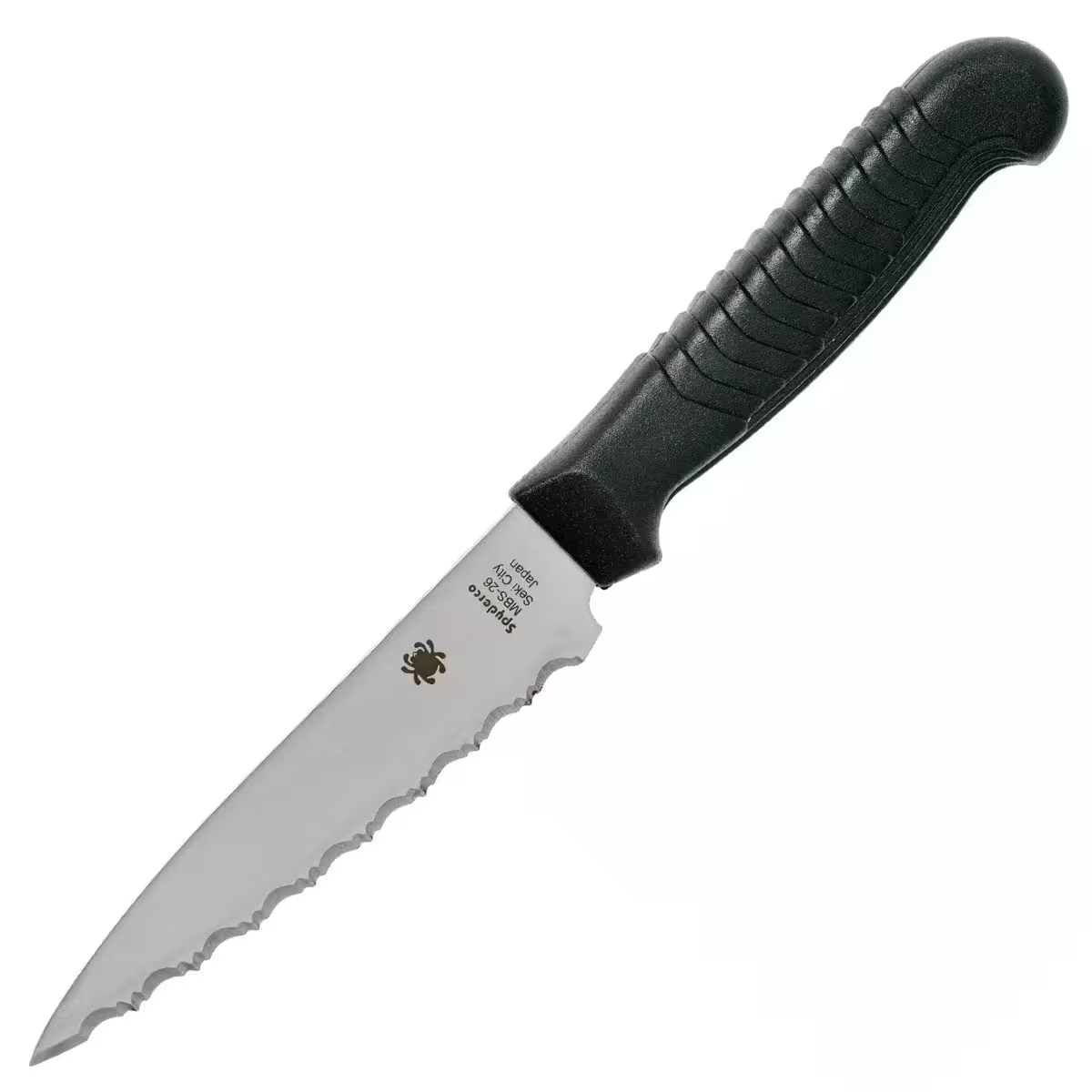
Spyderco RockJumper C254PBK Folding Knife
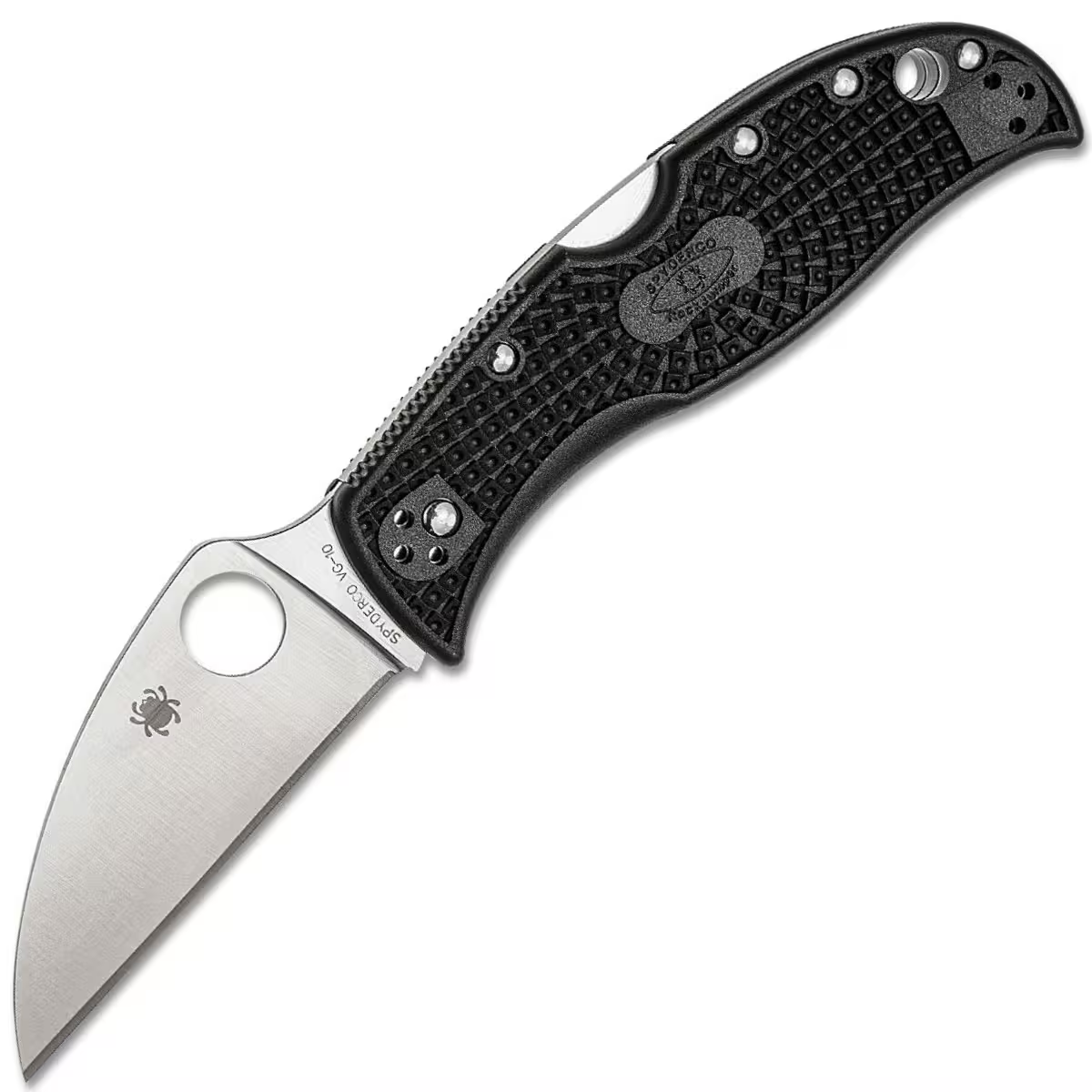
At first glance, the Spyderco RockJumper appears to be nothing more than a lightweight knife with a Wharncliffe blade sized to split the difference between Spyderco’s best-selling Delica 4 and Endura 4.
Detailed product description
Spyderco RockJumper C254PBK Folding Knife
At first glance, the Spyderco RockJumper appears to be nothing more than a lightweight knife with a Wharncliffe blade sized to split the difference between Spyderco’s best-selling Delica 4 and Endura 4. However, if you look a little deeper, you’ll realize that the subtle nuances of its design reflect a much deeper logic and extreme attention to detail—the kind that can come only from the mind of its designer, Spyderco founder Sal Glesser.
The RockJumper’s basic features are consistent with many of Spyderco’s lightweight, Japan-made folders: a VG10 stainless steel blade with a full-flat grind, the fully accessible Trademark Round Hole, a choice of PlainEdge or SpyderEdge configurations, skeletonized stainless steel liners, a robust lockback mechanism, an injection-molded fiberglass-reinforced nylon (FRN) handle, a high-traction Bi-Directional Texture pattern, and a four-position pocket clip. As “standard” as that may sound, the true magic of this design lies in how all of those proven features are expressed.
One of the RockJumper’s primary design goals was to pack as much cutting-edge performance as possible into its pocket-sized format while still using a mid-lock mechanism. An extended edge and minimal ricasso can be easily achieved with a LinerLock, Compression Lock, or other mechanisms that are not positioned in line with the blade; however, with lockbacks, they are challenging. Sal solved this problem by using a “handle-forward” design philosophy that extends the lower portion of the handle toward the heel of the edge. This brilliant solution allows the cutting edge to extend almost the full length of the blade and places the user’s hand farther forward for optimal control and leverage. Functionally, it provides the same ability to “choke up” on your grip as an index-finger choil, but without sacrificing any usable edge length. By minimizing the dead space between the front of the handle and the heel of the edge, the RockJumper’s design also significantly reduces the chance of snagging—especially when cutting rope or webbing in high-stress situations.
Sal insisted on a lockback mechanism for the RockJumper for several reasons. First, it complements the knife’s other features to make the design completely symmetrical and 100% ambidextrous in operation. Spyderco-style lockbacks also feature flat “kicks” (the area on the edge side of the ricasso) that “cam” fully against the lock bar. This unique feature prevents the blade edge from being dulled by contact with the inside of the handle and has always been a defining—yet underappreciated—feature of Spyderco lockbacks.
The locking mechanism also offers impressive strength and, equally important, a strong self-closing function. Compared to other mechanisms that are not positioned in line with the blade, the lockback snaps the blade closed with authority and keeps it there even during demanding activities such as climbing.
Like all Spyderco lockbacks, the mechanism on the RockJumper is more accurately categorized as a mid-lock. This style of lock places the lock release in the center of the handle for easy one-handed blade closing—especially when the index finger is positioned at the front of the handle and used as a stop. A variation of the traditional full-length lockback, the mid-lock was pioneered by Harvey McBurnette, Dick Dorough, and W.T. Fuller, who worked together in a tire factory in Alabama in the late 1960s. After Fuller tragically lost one hand in an industrial accident, all three men—machinists and aspiring knifemakers—worked together to design a folding knife for Fuller that could be easily opened and closed with one hand. The result was what they originally called a “front lock” folder. By shortening the lock bar of a traditional lockback mechanism and adjusting its spring tension, the three men created a folding-knife pattern that allowed easy lock release with only one hand. Interestingly, they also established a theme for their own careers as custom knifemakers, as all three eventually specialized in making fine handmade front-lock folders that are now highly prized collector’s items.
A few years later, in 1977, legendary knife designer Al Mar left his position at Gerber and founded Al Mar Knives. A former U.S. Army Special Forces soldier with a master’s degree in industrial design, Mar was deeply inspired by the custom makers of the time—including Harvey McBurnette. He appreciated the advantages of McBurnette’s front-lock/mid-lock design and decided to incorporate it into his tactically oriented line of folding knives. As a gentleman, Mar not only credited McBurnette for the inspiration, but also generously shared the secrets of the mechanism with Sal Glesser. When Mar introduced Sal to his Japanese knifemaking resources and helped plant the seeds of Spyderco knife production, he also gave Sal his blessing to use the mid-lock in all of his designs.
Unlike many other Spyderco lockbacks, the RockJumper does not include a Boye Dent—a scalloped recess in the lock bar that helps prevent unintentional lock release. The need for this feature is largely determined by the shape of the knife’s handle and how deeply the hand can engage the lock release. In the RockJumper’s case, the broad, hand-filling handle shape positions the lock release so that it contacts the hollow of the palm regardless of how the knife is gripped. Because of this, and the carefully shaped profile of the handle spine, the Boye Dent is unnecessary.
Similarly, the rear portion of the RockJumper’s blade spine lacks jimping (textured grooves), which are often found on other Spyderco folders. Again, this was a deliberate decision based on the specific ergonomics of the design, how it fits the hand, and how it rides in the pocket. Sal chose not to include it to eliminate any surfaces that might be too abrasive for the user’s hand or pockets.
Experienced knife users know that “one size fits all” is difficult to achieve in knife design. Human hands are organic and come in a wide range of shapes and sizes. Knife handles, by contrast, are fixed, inflexible objects. The RockJumper bridges the gap between those two extremes by offering a broad handle with very subtle curves that effectively “capture” the hand for a secure grip, while still comfortably accommodating almost all hand sizes. This unique design also enables intuitive tactile edge orientation and provides a large surface area that eliminates hot spots and reduces fatigue during prolonged use.
For fans of lanyards and fobs, the RockJumper includes an extra-large lanyard hole measuring 0.28 inches (7.1 mm) in diameter. The mounting holes for its four-position clip are also located at the distal points of both ends of the handle for an excellent balance between easy access and discreet carry.
Conceived as a full-service practical cutting tool for outdoor and everyday use, Sal named this knife the RockJumper because he felt its features made it an ideal cutting tool for climbers. We understand that climbers often have strong opinions for and against knives, but for those who include one in their kit, the RockJumper is hard to beat. For non-climbers, it’s even harder to beat.
Specifications
Closed Length: 11.2 cm
Blade Style: Wharncliffe
Blade Grind: Full-Flat
Blade Finish: Satin
Blade Edge: Plain
Handle Color: Black
Locking Mechanism: Lockback
Pocket Clip: Stainless Steel (Tip-Up/Down, Right/Left carry)
Model Number: C254PBK
Model Name: Rockjumper
Made in Japan
Key parameters
Overall length
19 cm
Blade length
7.8 cm
Weight
3,1 oz. (88 g)
Steel
VG10 stainless steel
Handle
FRN
Blade thickness
0.3 cm
Customer reviews
All 147 reviews →4,8
★★★★★
147 reviews · Heureka verified
You may also like
More →