Spyderco Yojimbo 2 Compression Lock Folding Knife C85GPBBK2
When Michael Janich designed his first knife for Spyderco nearly 20 years ago, most personal-defense knives featured traditional fighting blade profiles like spear points, Americanized tantos, and Bowie-style variations.
Free shipping.
Detailed product description
Spyderco Yojimbo 2 Compression Lock Folding Knife C85GPBBK2
When Michael Janich designed his first knife for Spyderco nearly 20 years ago, most personal-defense knives featured traditional fighting blade profiles like spear points, Americanized tantos, and Bowie-style variations. Janich’s design—the first-generation Ronin fixed blade—challenged that convention and literally pioneered the concept of the “tactical Wharncliffe.” Today, tactical Wharncliffe-style knives are everywhere, but the roots of that trend can be traced directly to Janich’s early designs—and Spyderco’s willingness to take a chance on them.
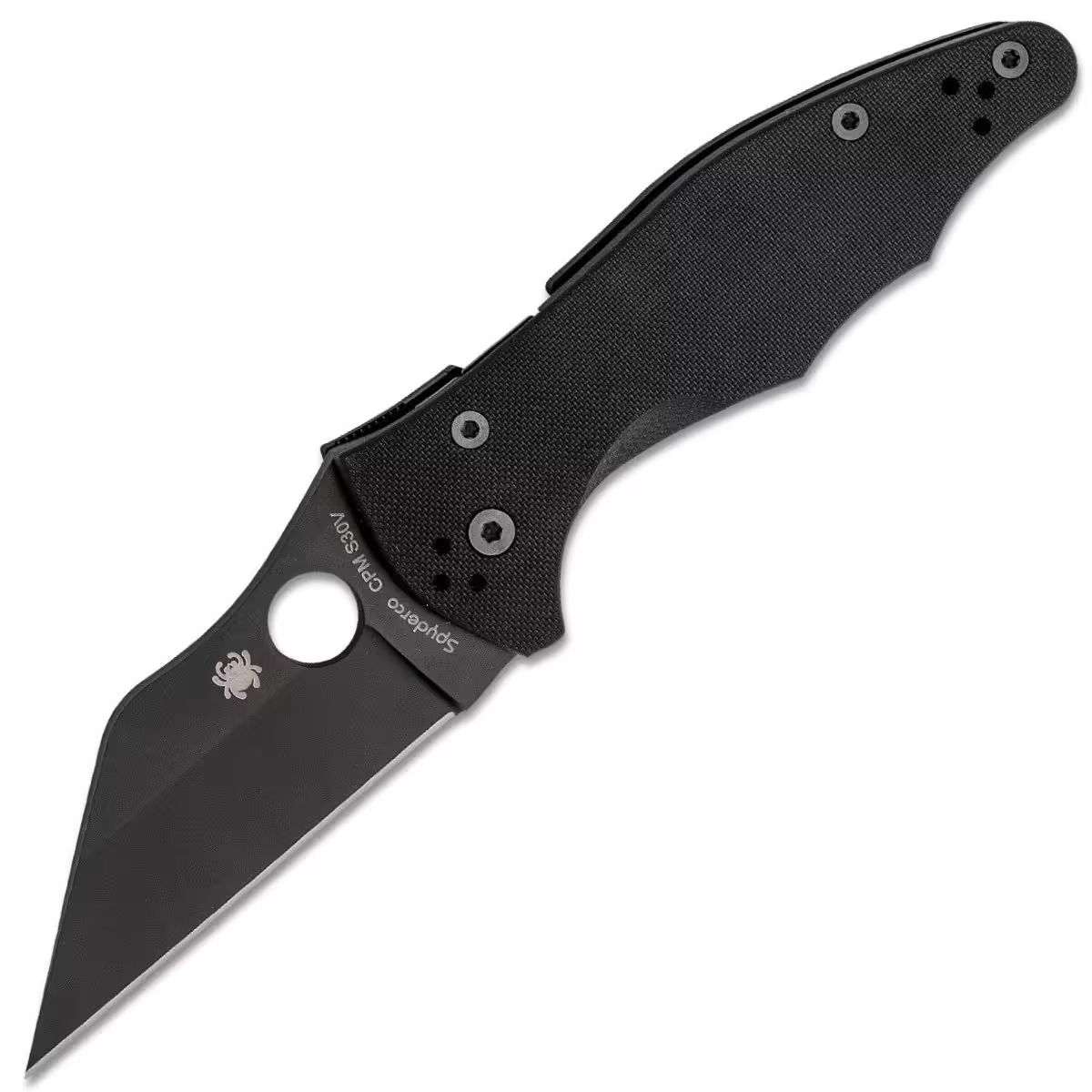
The newest addition to this family is an all-black version of Janich’s current Wharncliffe folder design, the Yojimbo 2. To fully appreciate this knife, however, it helps to know a bit about its development history.
The original Ronin (Japanese for literally “wave man,” a term for a masterless samurai) actually began as a collaboration with custom knifemaker Mike Snody. Janich wrote an article about one of Snody’s knives that became a turning point for him to become a full-time maker. As a gesture of thanks, Snody invited Janich to design the “ultimate neck knife,” which he would make as a custom blade. Although Janich had previously designed other knives, including the Tempest folder for Masters of Defense, he was determined to approach the design process from a fresh, empirical perspective.
He had already begun incorporating a demonstration called “Pork Man” into his knife self-defense classes to illustrate the cutting ability of small knives. Pork Man—a large pork roast tied around a wooden dowel and wrapped in multiple layers of plastic—not only demonstrated the cutting power of typical knives, but also quantified significant performance differences between various blade shapes.
To determine which blade styles sliced with the greatest effect, Janich invested a small fortune in pork roasts, built an army of Pork Men, and started cutting. To his surprise, of all the knives in his collection, the best cutters were a pair of Spyderco “gentleman’s” folders designed by Frank Centofante with classic Wharncliffe-style blades (C25 and C50).
As Janich dug deeper, he realized that the secret of Wharncliffe blades lies in their perfectly straight edges that cut with full force all the way to the tip. In contrast, the cutting power of blades with upward-curving edges and lots of “belly” diminishes near the point. The needle-like tip of a Wharncliffe also penetrates almost effortlessly during thrusts. Despite their refined appearance, Wharncliffes are tactical slicing and thrusting machines.
Armed with that knowledge, the Ronin design Janich presented to Snody was a pure Wharncliffe. At first, Snody wasn’t enthusiastic about it and began backing away from the offer. But when he finally made one and cut with it, he was blown away. In the end, he not only produced a series of custom Ronins, but also shifted the direction of his own knife designs to focus heavily on Wharncliffe blades.
At about the same time (1999), Spyderco founder Sal Glesser invited Janich to take over as instructor of the “Martial Blade Craft” program. Sal had recently attended James Keating’s “Riddle of Steel” training camp and wanted Spyderco to host a series of knife self-defense classes at our headquarters in Golden. As the program gained momentum, Sal also thought it would be a good idea for Janich to design a signature Spyderco knife that reflected his knife-tactics system. Janich showed Sal the Ronin, explained the logic behind it, and drove the point home with the help of Pork Man. Sal liked what he saw, and the Spyderco Ronin was born.
At the time, Spyderco’s fixed-blade market was still limited, so Sal asked Janich to design a folder as well. Janich was already working on a rough prototype of a folding tactical Wharncliffe, so he quickly modified the design to include Spyderco’s trademark Round Hole and delivered a set of drawings along with his own handmade plastic concept model of the design. Sal liked the design, but development moved slowly, so Janich decided to “tip the scales” a bit. He went back to Mike Snody and commissioned a special one-off version of his design, which he named Yojimbo (Japanese for “bodyguard”). Snody graciously made the knife, posted photos of it online, and mentioned that Spyderco might be working on a production version.
The Spyderco Yojimbo followed shortly after, in 2003. It was manufactured in Spyderco’s factory in Golden, CO and featured a full-flat-ground CPM S30V Wharncliffe blade, nested stainless steel liners, blue or black textured G10 scales, and an early version of the Compression Lock mechanism. Its three-inch blade was intentionally shorter than the tapered handle, because Janich originally designed it to be legal for air travel, even during heightened security alerts. After 9/11, that design feature became moot, but the knife was still legal to carry almost everywhere.
While many dismissed it as a “box cutter on steroids,” the Yojimbo gained more market traction than the Ronin. However, when Janich accepted a management position with another knife company in 2004, he and Spyderco decided to remain friends but stop designing together.
Janich continued his Wharncliffe campaign with several more designs until 2009, when he joined Spyderco as a full-time employee. Although his duties focused mainly on technical writing and product education, he soon also joined Spyderco’s research and development team. He was also asked to create another signature design reflecting his personal-defense knife philosophy. Fully applying the lessons he had learned from the first Yojimbo, he designed the Yojimbo 2, which was released at the end of 2011.
The more refined Yojimbo 2 design—supported by Janich’s tireless promotion of the Wharncliffe as a tactical blade profile—helped it earn a solid place in Spyderco’s product line. Because it was purpose-built as a self-defense knife, a dedicated trainer model joined the live-blade version in 2017. In an interesting example of “reverse evolution”—and with help from custom knifemaker Mickey Yurco—the Yojimbo 2 also inspired a nearly identical fixed-blade counterpart, the Ronin 2.
Based on its enduring popularity and repeated requests from members of the Spyderco forum, we are proud to announce the latest addition to the Spyderco/Janich Wharncliffe family: the all-black Yojimbo 2. Like the satin-bladed version, it features a hollow-ground CPM S30V blade, Compression Lock, peel-ply-textured G-10 scales, and a four-position hourglass pocket clip. However, all parts of the knife—including the stainless steel liners and Compression Lock—are cloaked in a non-reflective black coating. The blade is coated with Diamond-like Carbon (DLC), and all other parts also feature durable black coatings appropriate to their base materials. In addition to satisfying Yojimbo 2 fans who demanded an all-black version, this knife is historically significant because it is the first Compression Lock model with black-coated liners.
Although tactical-themed Wharncliffes are common today, the evolution of this breed began with the efforts of Michael Janich, Spyderco, and the spirit of collaboration and innovation they have shared for more than 20 years.
Specifications
Closed Length: 11.22 cm
Blade Style: Wharncliffe
Blade Grind: Hollow
Blade Finish: Black DLC
Blade Edge: Plain
Handle Color: Black
Locking Mechanism: Compression Lock
Pocket Clip: Tip-Up/Down, right/left carry
Model Number: C85GPBBK2
Model Name: Yojimbo 2
Designer: Michael Janich
Made in USA
Key parameters
Overall length
19.22 cm
Blade length
8 cm
Weight
4,1 oz.
Steel
CPM-S30V stainless steel
Handle
G10
Customer reviews
All 147 reviews →4,8
★★★★★
147 reviews · Heureka verified
You may also like
More →